Guide · updated 2026-09-04
It is the first thing people ask before booking anything in Cancun, and most operators answer it badly. Here is what we see from the water, most days of the year.
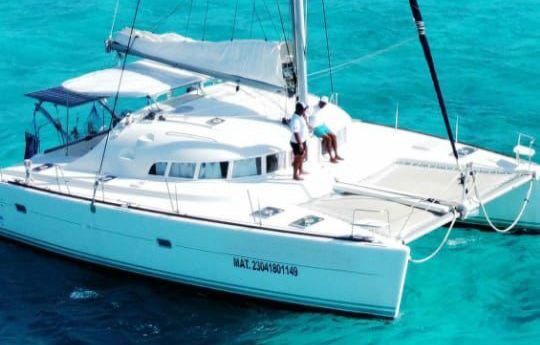
Playa Norte and Punta Sur, on Isla Mujeres, stay free of sargassum all year. Not "usually". Not "most of the season". The sand on that side of the island stays clean, and it is the single biggest reason a catamaran day out of Cancún is a safer bet than a hotel-zone beach day when sargassum is running.
That is not marketing. It is geography, and it is worth understanding, because it also tells you which beaches to avoid.
Sargassum arrives on ocean currents from the open Atlantic. What determines whether a beach ends up buried in it is not how much is floating around — it is whether the water in front of that beach keeps moving.
The Cancún hotel zone faces the open Caribbean along a long, exposed strip. When sargassum arrives there, the current slows against the shore and the weed stagnates. It piles up, it sits, it rots, and crews spend the morning raking it.
The west-facing side of Isla Mujeres — the side that looks back toward Cancún, where Playa Norte sits — works the opposite way. The current runs past rather than into it. Nothing stagnates, so nothing accumulates on the sand. Punta Sur, at the other end of the island, behaves the same way.
This is why you can stand on Playa Norte on a day when the hotel zone is having a bad sargassum morning and see clean white sand and clear water. Same sea, different hydrodynamics.
Here we will be straight with you, because this is where operators tend to overpromise.
At the reef stops — El Meco and the shallow reef offshore from Playa Norte — there are days when you can feel some sargassum in the water. It brushes past you. It is present.
It does not ruin the snorkelling. It is light, it moves through, and in years of running these stops it has never been the thing that made a guest cut a swim short. Visibility at the reef stays in the 10 to 20 metre range regardless, and the captain picks whichever of the two stops is cleanest and calmest on the day — which is exactly the kind of decision you cannot make from a fixed-schedule tour boat.
So: light and occasional at the reef, absent on the beach. That is the honest version.
Across the Mexican Caribbean the heavier months tend to run from around April through August, with the worst of it usually landing between May and July. It varies enormously year to year — some seasons barely register, others are difficult along the mainland coast.
What does not vary much is the pattern above. Even in a heavy year, the sheltered side of Isla Mujeres is where the clean sand is. It is the reason locals call Playa Norte the jewel of the Caribbean and mean it literally, not as a brochure line.
If sargassum is what you are worried about, a day on the water is the strongest move available to you:
That last point is the one people underestimate. A private charter can change its mind. A hundred-passenger shared boat on a fixed route cannot.
And if the forecast turns against the water altogether, the other reliable answer is to spend the day inland: Chichén Itzá Airplane Tours flies from Cancún to the ruins and back in a morning, and sargassum never enters the equation.
Conditions change. Rather than trusting a page written months ago — including this one — send us a message before you book and we will tell you what the water looked like on our last charter. We run out of Marina Marazul most days and we would rather you arrive with accurate expectations than a good sales pitch.
No. Playa Norte and Punta Sur on Isla Mujeres stay free of sargassum year round, because the current in front of them keeps moving instead of stagnating the way it does along the Cancún hotel zone.
No. There are days when you feel some sargassum in the water at the reef stops, but it is light and passing. Visibility stays around 10 to 20 metres, and the captain picks whichever stop is cleanest on the day.
Generally April through August, with May to July usually the heaviest. It varies a lot year to year, and it affects the mainland hotel-zone beaches far more than the sheltered side of Isla Mujeres.
Private catamaran prices in Cancun: whole-boat rates from $1,050 to $6,500 USD, what it works out to per guest, and the costs most quotes leave off.…
Private catamaran charter or shared party boat in Cancun? What each costs, who each suits, and when the shared tour is honestly the better buy.…
Directions to Marina Marazul, Puerto Juarez: both routes off Avenida Bonampak, the landmarks to watch for, and what parking is really like.…
Wind, water temperature, crowds and prices month by month in Cancun, plus what the canicula and El Nino actually do to a sailing day on the Bahia de M…
Send your dates and group size on WhatsApp. We answer ourselves, usually within the hour, and we will tell you honestly whether we are the right fit.